
Ohio’s 2026 Senate race is one of the most expensive elections in US history, with estimated spending above $500 million through October, and intense activity continuing to the end of election day today. For people in and connected to Ohio, the tide of political advocacy is inescapable across saturated media and ubiquitous ground campaigning, illustrated by seemingly infinite billboards, placards, and yard signs.
In addition to the state-level Senate contest, with its direct federal and national implications for the winner and their party, Ohio is channeling the zeitgeist at local levels, with individual people and communities responding to the largest number of data center ballot issues in the U.S.
So what’s the carbon footprint and climate impact of this avalanche of political advertising? And what would it cost to offset that amount of carbon and it’s impact?
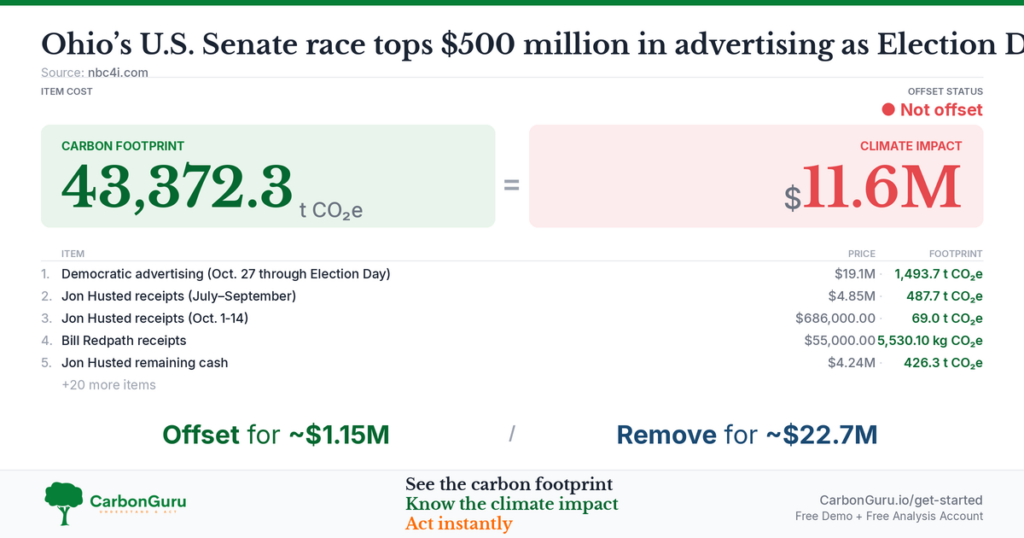
I used CarbonGuru to estimate the carbon footprint, climate impact, and matching offsetting for the Ohio Senate race spending reported by local and national sources.
Considering the campaign as one overall advertising effort, CarbonGuru estimates that $500 million in advertising represents approximately 39,100 tonnes of CO₂e, with $10.5 million in climate impact.
Modeling the individual campaigns, donors / advocacy groups, activities, and time periods reported yields a (slightly higher, given the different types of organizations and activities identified) total estimate of 43,372 tonnes of CO₂e, with $11.6 million in climate impact.
Like the blockbusting footprint of the (also Ohio-based…) world’s largest data center, CarbonGuru’s reference products list does not include an everyday item with a footprint comparable to the 2026 Senate campaign.
Politics, advertising, and entertainment have strong resonances, especially as they manifest in media, so let’s be generous with possible parallels: How much Netflix do we get for that 43,372 metric tonnes of carbon?
One month of Netflix at the $17.99 tier has a footprint of 1.50 kg CO₂e, meaning the Ohio election race equates to ~28.8 million monthly Netflix subscriptions.
That’s a bit less than 6 months of Netflix, for every single one of the 5 million households in Ohio.
What about offsetting all that carbon, and the climate impact it will have?
Addressing that overall advertising footprint costs a small fraction of the money spent: approximately $1.04 million for matching offsets, or 0.21% of the $500 million analyzed. Carbon removals would cost approximately $20.5 million, or 4.1%.
Politics – at least the advertising and campaigning – is comparatively affordable to offset.
Connecting campaign spending to carbon footprints makes the impact something the campaigns, outside advocates, and the wider public, can understand and act on.
Sources: NBC4 reporting · CarbonGuru analysis · Crain’s Cleveland Business · OpenSecrets outside spending · CarbonGuru Netflix footprint