Manoa REDD+

Avoided Deforestation Avoided Emissions Brazil

Project Description

The Manoa REDD+ is one of the most effective avoided deforestation projects in the world. Located on the edge of the Amazon rainforest, the project protects 81,150 hectares of rainforest from illegal deforestation and conversion to agriculture and pasture.

Key Information

Developer Biofรญlica Ambipar Environment
Project Type Avoided Deforestation
Impact Type Avoided Emissions
Methodology VM0015 v1.1
Verifier Earthood
Project Lifetime 2013 – 2042

Due Diligence

CNaught maintains a very high quality standard for all projects in the portfolios we manage. To ensure that a project meets this standard, we perform due diligence thatโ€™s backed up by third-party ratings agenciesโ€™ independent due diligence. 

 Understanding The Ratings

โ€Carbon credit rating agencies apply different methodologies that can lead to highly variable assessments of the same project. Calyx Global’s approach penalizes projects with shorter crediting periods and applies standardized baseline criteria, meaning the quality nature-based projects may not be accurately assessed. By contrast, BeZero, Renoster, and Sylvera employ methodologies that place greater emphasis on demonstrated effectiveness, context-specific deforestation patterns, and practical risk mitigation measures. These agencies recognize the project’s strong evidence of financial additionality given changing market conditions, conservative baseline calculations, and robust governance structures that collectively support long-term carbon storage. Our due diligence process synthesizes multiple independent rating perspectives with our own analysis to deliver a more complete, confident assessment of a project’s true climate impact.

โ€
Additionality:
This project has high additionality. The project area was previously managed under sustainable FSC best practices for forest management, but now faces significant challenges.Illegal deforestation in the surrounding region has surged in recent years, creating heightened pressure on the project area’s forests. Simultaneously, the declining local timber market has reduced the financial returns that previously supported the sustainable management practices. Without additional financing, it would be extremely difficult, if not impossible, to continue the project’s conservation activities. The project has thoroughly documented both financial and regulatory additionality factors, providing strong evidence that carbon finance is necessary to maintain forest protection in the face of these growing economic and environmental pressures.

โ€
Over-Crediting:
This project has low risk of over-crediting, meaning it is likely to have accurately accounted for the amount of carbon being sequestered. The project employs a particularly conservative baseline approach by using a reference region that includes areas further from roads with lower deforestation rates than those directly adjacent to the project area that face higher pressure. In fact, our analysis suggests the project is likely under-estimating its impact, as their baseline emissions are proportionally lower than our independent estimate as well as that of Renoster and Sylvera. Although we noted a minor concern regarding leakage accounting, with deductions only applied for two years. Given the projectโ€™s heavy investment in leakage-reduction efforts with the local community, these limited deductions may be warranted and do not raise the over-crediting risk above minimal levels.

โ€
Durability:
This project activity is highly durable as we are confident in its ability to provide permanent emissions removals. The project has implemented a rigorous fire detection and prevention system, including the construction of fire roads and monitoring stations and the training of a fire brigade. Its location in a tropical rainforest ecosystem provides natural resilience to disturbances and the project has proven that it is highly effective at preventing illegal deforestation in the project area.

โ€
Double-Counting:
The project credits have a very low risk of being double counted. There are no regulatory obligations being met by the project activity and the projectโ€™s registry, Verra, has mechanisms in place to ensure that the project is not registered in any other programs. Brazil recently passed carbon regulations (Law 15042/2024) which establish a national Emission Trading System that is well linked with other credit issuance programs such as Verra to ensure that credits are not counted under both mechanisms. We also confirmed that the project does not overlap with any other forest carbon projects to ensure that its credits are not claimed by other projects.

Due Diligence Diagram

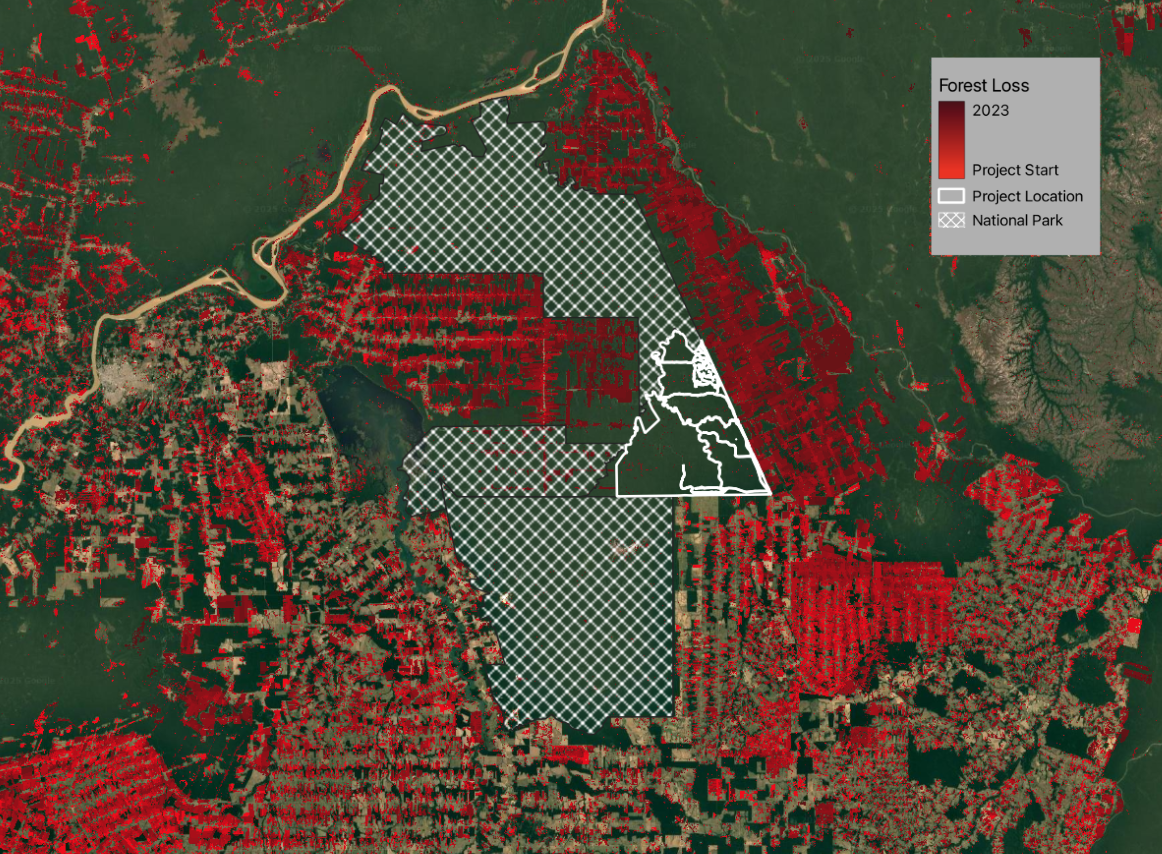
The project is in an area with very high deforestation pressure, as the majority of the surrounding area has experienced heavy forest loss in the past 25 years. The minimal forest loss in the project area shows that the project has been successful at preventing deforestation.

Beyond Carbon

Community and biodiversity co-benefits

This project delivers substantial community and biodiversity benefits through its sustainable forest management practices in Rondรดnia, Brazil. 

โ€

Community: While the project area itself does not contain community groups, it creates positive local impact by employing 40 residents from surrounding areas and providing forest management training to 90 people annually. The project also established the Manoa Forest Education Center (CEFLOM), which educates workers and students on environmental conservation principles. Additionally, the project supports 22 local industries by integrating sustainable materials into their value chains, contributing to regional economic development.

โ€

Biodiversity: The project protects a remarkably biodiverse ecosystem harboring 177 flora species and 785 fauna species, including 32 endangered or critically endangered species. The protected area serves as a vital wildlife corridor between national parks, enhancing regional habitat connectivity. The project implements active monitoring and patrolling to combat illegal loggingโ€”the primary threat to local biodiversityโ€”and facilitates scientific research through a partnership with the Federal University of Rondรดnia Foundation.

โ€

Risk of Reversal

Nature-based projects like this one face some risk of reversal. Carbon storage may be affected by natural hazards such as wildfires, flooding, and escalating climate change impacts. Additionally, human-driven factors such as changes in land use or local governance structures can also impact carbon storage.

Registry & Verification

Registry Verra
Project ID 1571
Verification Body Earthood

Notable Buyers

Organizations that have purchased credits from this project

In the News

Is the plan to have companies pay to protect forests too flawed to ever work?

Fast Company ยท Jun 21, 2023

CNaught’s take: REDD projects provide a valuable service to the world by protecting critical forests and helping reduce global carbon emissions. However, many of these projects have been found to be over-credited, meaning they overestimate their climate impact and issue more credits than they should have. This has caused much of the voluntary carbon market to turn away from REDD projects. This article shows how other REDD projects can learn from Manoa, a model forest conservation project that has been reviewed favorably by many ratings agencies.

Revealed: more than 90% of rainforest carbon offsets by biggest certifier are worthless, analysis shows

The Guardian ยท Jan 18, 2023

CNaught’s take: This widely publicized article claims that most rainforest carbon offsets certified by Verra delivered minimal climate benefits, based on a study that found that several projects (including Manoa) used inflated baselines resulting in over-crediting. However, this conclusion stems from methodologically flawed baseline assessments, as detailed in Verra's comprehensive rebuttal. Independent research from multiple respected carbon credit experts including Pachama and Sylvera directly contradict these findings. Their rigorous analyses revealed that Manoa's baseline calculations were actually highly conservative and that the project delivers genuine emissions reductions. This demonstrates the importance of looking beyond headlines and conducting thorough due diligence and multi-source verification to ensure the most accurate assessment of project integrity.

Voluntary Carbon Market Rankings 2024

Environmental Finance ยท Dec 1, 2024

CNaught’s take: Each year, Environmental Finance issues awards to organizations making the greatest impact in the voluntary carbon market. In 2024, Manoa came in second place for the worldu2019s greatest individual offsetting project. This award reflects how impactful this project is.

Brazil plans new Amazon routes linking the Pacific & Chinau2019s New Silk Road

Mongabay ยท Mar 31, 2025

CNaught’s take: China's Belt and Road Initiative is accelerating new infrastructure plans cutting through the Amazon, including routes connecting Brazil to Pacific ports. These developments threaten the rainforest as they historically lead to deforestation, with research showing 95% of Amazon clearing occurs within 5.5 km of roads. This infrastructure expansion makes forest conservation projects in Brazil, such as Manoa, more valuable than ever, serving as critical counterbalances to development pressures that have already caused a 190% increase in environmental violations in areas like the planned Ferrogru00e3o railway region.

UN Sustainable Development Goals

This project contributes to the following UN Sustainable Development Goals

UN Sustainable Development Goal 4: Quality Education

Goal 4: Quality Education

Ensure inclusive and equitable quality education and promote lifelong learning opportunities for all.

Learn more about UN SDG 4
UN Sustainable Development Goal 8: Decent Work and Economic Growth

Goal 8: Decent Work and Economic Growth

Promote sustained, inclusive and sustainable economic growth, full and productive employment and decent work for all.

Learn more about UN SDG 8
UN Sustainable Development Goal 15: Life on Land

Goal 15: Life on Land

Protect, restore and promote sustainable use of terrestrial ecosystems, sustainably manage forests, combat desertification, and halt and reverse land degradation and halt biodiversity loss.

Learn more about UN SDG 15
UN Sustainable Development Goal 17: Partnerships for the Goals

Goal 17: Partnerships for the Goals

Strengthen the means of implementation and revitalize the Global Partnership for Sustainable Development.

Learn more about UN SDG 17

Project Location

Brazil

Coordinates: -9.00000, -62.53000

View on Google Maps

Project data sourced from CNaught carbon marketplace. Information may be updated periodically.