
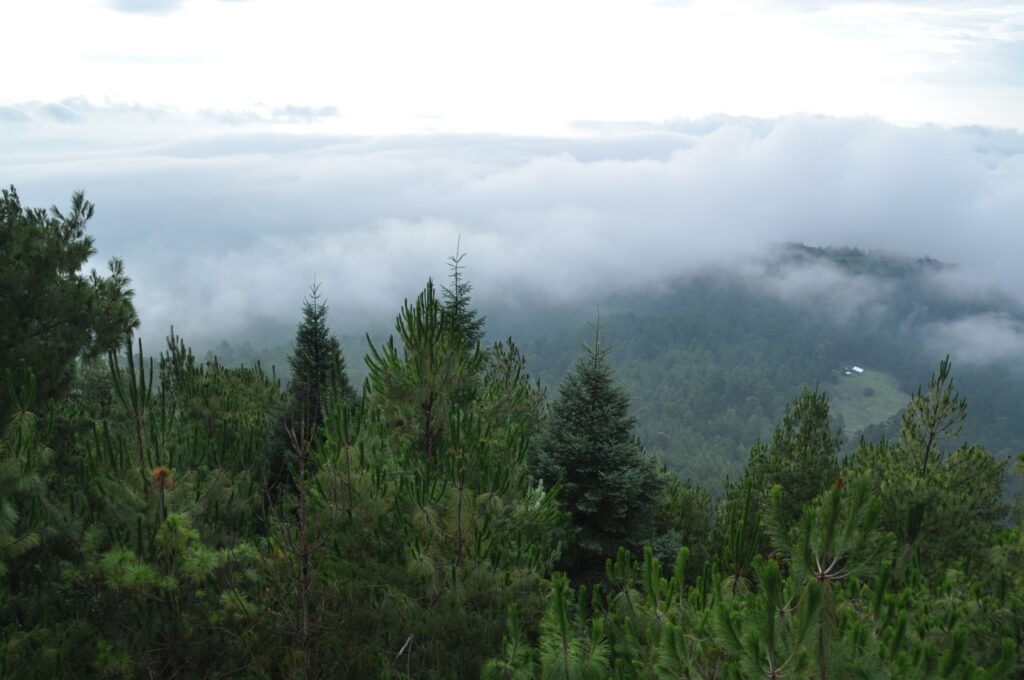
Nuevo San Juan Improved Forest Management
Project Description
This improved forest management project increases carbon capture across over 18,000 hectares of indigenous community-managed forest in Michoacán, Mexico, where the local community of Nuevo San Juan Parangaricutiro has sustainably managed their lands for nearly 40 years. The project implements enhanced forest management practices including pest and disease monitoring, fire prevention and control, surveillance against illegal logging, reforestation with native species, forest restoration, vegetation clearing in regeneration areas, pruning and thinning, and silvicultural treatments that optimize forest soil productivity while protecting biodiversity. These improved management actions also help the community defend the forests against the growing threat of illegal avocado plantation conversion, a significant problem in the region where half of avocado farms are unauthorized and create strong economic pressure to clear forests. The carbon credit revenue provides crucial funding to maintain these enhanced protection measures at a time when government conservation support has declined, helping ensure these biodiverse forests continue to store increased amounts of carbon, support local livelihoods, and protect important wildlife habitat for generations to come.
Key Information
Developer
Servicio y Consultoria Ambiental y Foresta
Project Type
Improved Forest Management
Impact Type
Removal
Permanence
100
Methodology
CAR Mexico Forest Protocol 3.0
Verifier
TUV SUD
Project Lifetime
2020 – 2050
Oxford Category
Oxford Type 4—Nature-based Removals
Due Diligence
CNaught maintains a very high quality standard for all projects in the portfolios we manage. To ensure that a project meets this standard, we perform due diligence that’s backed up by third-party ratings agencies’ independent due diligence.
Additionality:
This project has high additionality, meaning it is very unlikely that this project activity could have occurred in the absence of carbon funding. The Indigenous Community of Nuevo San Juan Parangaricutiro has successfully operated sustainable forest management for nearly 40 years through their Forestry Development Program, which was financially supported by the government and generated some revenue from pine resin operations and timber. However, the landscape has fundamentally shifted with two critical developments that now make carbon revenue necessary for continued forest protection. First, the region faces severe and growing pressure from illegal avocado plantation conversion, with Michoacán accounting for 80% of Mexico’s avocado production and an estimated 50% of plantations being unauthorized. Strong social and economic pressures drive communities throughout the state to clear forests for lucrative avocado cultivation, creating unprecedented threats that require the project to conduct daily surveillance and coordinate with authorities to prevent illegal deforestation. Second, government funding for forest conservation has significantly decreased in recent years, with the community receiving no support since 2019. While state and federal laws incentivize sustainable management, funding cuts have severely undermined their effectiveness at precisely the moment when external threats have intensified. Carbon finance now provides the incremental funding necessary to maintain enhanced protection measures including daily patrols and surveillance infrastructure that defend against widespread forest conversion pressures in a region where illegal deforestation for avocado plantations has become endemic.
Over-Crediting:
This project has a low risk of over-crediting, meaning that it is likely to have accurately accounted for the amount of carbon emissions being avoided and removed from the atmosphere. The project demonstrates conservative carbon accounting through several methodological safeguards that reduce the likelihood of inflated credit claims. Baseline carbon stocks are fixed at project start date levels throughout the entire project lifetime, eliminating the risk of inflated baselines. Business-as-usual harvesting levels are conservatively capped at the six-year pre-project average, and remote sensing verified that there is no evidence of increased forest clearing prior to project start to maximize credits. Satellite imagery also confirms strong alignment between reported and actual forest behavior, with the project’s claimed carbon stock growth in standing wood pools matching detected forest canopy behavior. Additionally, reported harvesting volumes align well with detected clear-cutting activity, with high reported volumes appropriately explained by the inclusion of thinning and other non-clear-cut harvesting methods beyond what satellite imagery captures. Market leakage is conservatively quantified through an individual approach across eight activity areas: a 20% default leakage factor is applied to all areas harvesting below business-as-usual levels.
Durability:
This project activity is highly durable as we are confident in its ability to provide permanent carbon removals. The project benefits from strong land tenure security with no disputes according to the Agrarian Attorney’s Office, and the Indigenous Community of Nuevo San Juan Parangaricutiro has a proven 40-year track record of successful forest stewardship with diversified revenue streams including pine resin, timber, fertilizer, and ecotourism that provide financial resilience beyond carbon credits. Fire risk is moderate despite no significant impacts recorded between 2001-2022, as fire risk is projected to increase over the next 30 years under climate change scenarios. This increasing risk is mitigated by the community’s extensive fire management infrastructure including fire breaks, warning signage, detection towers, year-round surveillance patrols, and trained permanent and auxiliary fire brigades. Pest outbreak risk is moderate as the project is located in a high-risk zone for bark beetles, with 60% of tree species being pines; however, the project’s polyculture composition of native species reduces susceptibility to severe outbreaks, and monthly patrols by specialized technical personnel monitor for early pest detection with no issues reported to date. Drought risk is moderate and increasing under climate projections, though no severe historical droughts have been observed through 2022 and the project’s implemented thinning practices reduce inter-tree competition and accelerate growth recovery. The most significant durability strength comes from active management of anthropogenic risks: the community conducts daily surveillance patrols and coordinates with authorities to successfully defend against external pressures from illegal avocado plantation conversion, which represents 50% of the state’s avocado cultivation and creates persistent deforestation pressure throughout the region.
Double-Counting:
The project credits have a very low risk of being double counted. There are no regulatory obligations being met by the project activity and the project’s registry, Climate Action Reserve, has mechanisms in place to ensure that the project is not registered in any other programs. We also confirmed that the project does not overlap with any other forest carbon projects to ensure that its credits are not claimed by other projects.
Project is located in an area where sustainable forest management is not common practice. Image shows that the majority of the surrounding area is either deforested or degraded, with the exception of trees on slopes too steep to harvest.
Beyond Carbon
Community and biodiversity co-benefits
This project delivers substantial community and environmental benefits.
Community: The project supports the 1,254 members of the Indigenous Community of Nuevo San Juan Parangaricutiro, who have successfully managed their forest resources for 40 years through a highly democratic governance model. The community operates 10-11 community businesses that generate over 1,000 jobs annually, including 800 permanent and 300 temporary positions across sawmills, furniture factories, resin and polymer facilities, fertilizer marketing, avocado orchards, water bottling, and ecotourism enterprises. This diversified economic structure has helped the community achieve low marginalization levels, placing it in the top 8% nationally for social and economic development. Carbon credit revenues are distributed among community members and support employment through fire brigades, pest monitoring patrols, reforestation activities, and surveillance against illegal logging. The project strengthens the community’s capacity to defend their lands against external threats, particularly illegal avocado plantation conversion, through daily surveillance patrols and coordination with local authorities. Monthly General Assemblies involving all community members ensure equitable decision-making and benefit-sharing, maintaining the democratic governance that has sustained this successful model of indigenous forest stewardship for decades.
Environment: The project protects highly biodiverse forest within the Tancítaro Key Biodiversity Area, with 16.7% overlapping the Pico de Tancítaro flora and fauna protection area. The forest supports approximately 640 animal, fungi, and plant species, with 3.3% currently threatened according to IUCN Red Lists. The project maintains over 95% native species composition with Pinus pseudostrobus and 20+ other native species, well below single-species dominance thresholds that would indicate plantation forestry. FSC certification ensures sustainable harvesting practices that minimize biodiversity harm, with small buffers established around water sources excluded from forestry use. Wildlife management units protect white-tailed deer and red deer populations, while the project supports watershed protection across multiple river basins. Enhanced management activities including monthly specialized pest and disease patrols, fire prevention infrastructure with detection towers and trained brigades, manual soil preparation for reforestation to prevent erosion, and year-round resin operations ensure permanent community presence throughout the forest for ecological monitoring and protection against illegal activities that would otherwise convert this biodiverse forest to avocado monoculture.
Risk of Reversal
Nature-based projects like this one face some risk of reversal. Carbon storage may be affected by natural hazards such as wildfires, flooding, and escalating climate change impacts. Additionally, human-driven factors such as changes in land use or local governance structures can also impact carbon storage.
Registry & Verification
Notable Buyers
Organizations that have purchased credits from this project
Third Party Labels
Project Location
Project data sourced from CNaught carbon marketplace. Information may be updated periodically.