CNaught maintains a very high quality standard for all projects in the portfolios we manage. To ensure that a project meets this standard, we perform due diligence that’s backed up by third-party ratings agencies’ independent due diligence.
Understanding The Ratings
Carbon credit rating agencies apply different methodologies that can lead to highly variable assessments of the same project. Calyx Global’s approach penalizes projects with shorter crediting periods and applies standardized baseline criteria, meaning the quality of nature-based projects may not be accurately assessed. By contrast, BeZero, Renoster, and Sylvera employ methodologies that place greater emphasis on demonstrated effectiveness, context-specific deforestation patterns, and practical risk mitigation measures. These agencies recognize the project’s strong evidence of financial additionality given changing market conditions, conservative baseline calculations, and robust governance structures that collectively support long-term carbon storage. Our due diligence process synthesizes multiple independent rating perspectives with our own analysis to deliver a more complete, confident assessment of a project’s true climate impact.
Additionality:
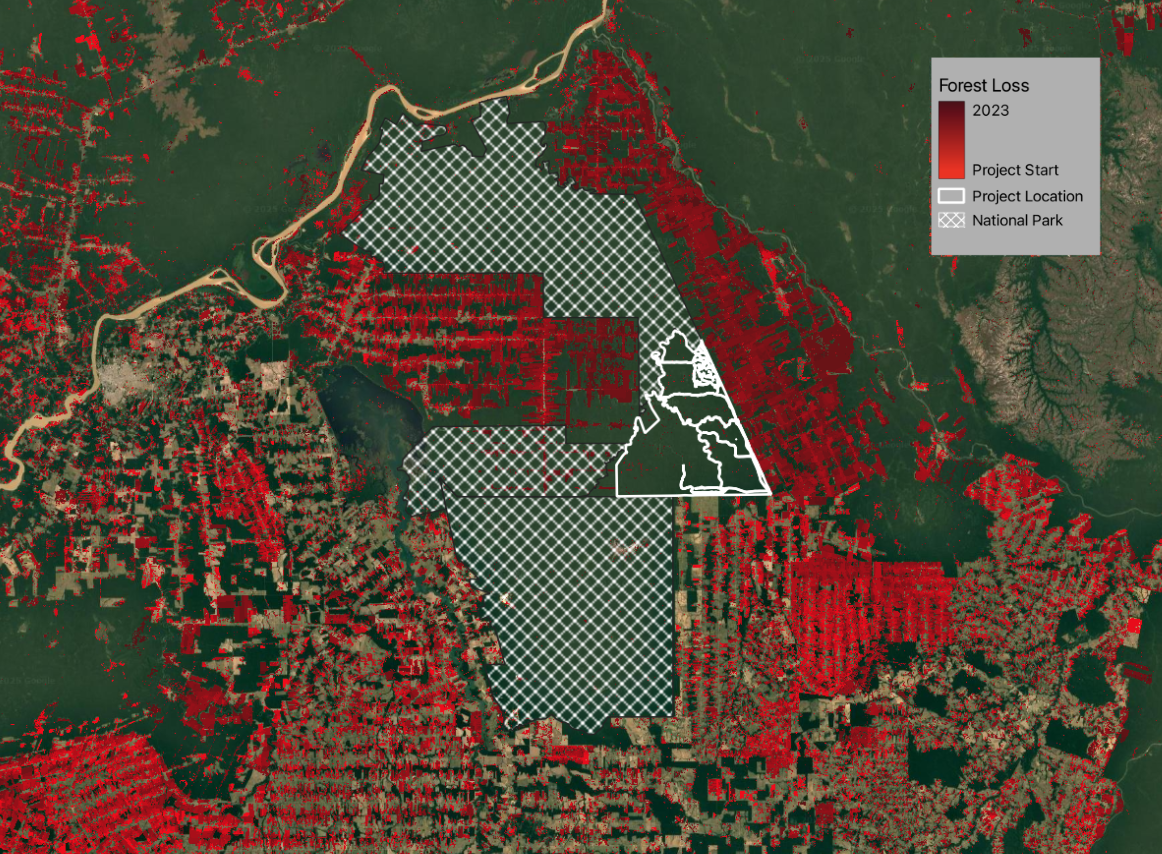
This project has high additionality. The project area was previously managed under sustainable FSC best practices for forest management, but now faces significant challenges. Illegal deforestation in the surrounding region has surged in recent years, creating heightened pressure on the project area’s forests. Simultaneously, the declining local timber market has reduced the financial returns that previously supported the sustainable management practices. Without additional financing, it would be extremely difficult, if not impossible, to continue the project’s conservation activities. The project has thoroughly documented both financial and regulatory additionality factors, providing strong evidence that carbon finance is necessary to maintain forest protection in the face of these growing economic and environmental pressures.
Over-Crediting:
This project has low risk of over-crediting, meaning it is likely to have accurately accounted for the amount of carbon being sequestered. The project employs a particularly conservative baseline approach by using a reference region that includes areas further from roads with lower deforestation rates than those directly adjacent to the project area that face higher pressure. In fact, our analysis suggests the project is likely under-estimating its impact, as their baseline emissions are proportionally lower than our independent estimate as well as that of Renoster and Sylvera. Although we noted a minor concern regarding leakage accounting, with their deduction being reduced slightly after two years based on modeled impacts of their leakage-reduction efforts, rather than measured impacts. Given the project’s heavy investment in leakage-reduction efforts with the local community, these limited deductions may be warranted and regardless, given that the change is only from 12% to 10% leakage deduction, do not raise the over-crediting risk above minimal levels.
Durability:
This project activity is highly durable as we are confident in its ability to provide permanent emissions removals. The project has implemented a rigorous fire detection and prevention system, including the construction of fire roads and monitoring stations and the training of a fire brigade. Its location in a tropical rainforest ecosystem provides natural resilience to disturbances and the project has proven that it is highly effective at preventing illegal deforestation in the project area.
Double-Counting:
The project credits have a very low risk of being double counted. There are no regulatory obligations being met by the project activity and the project’s registry, Verra, has mechanisms in place to ensure that the project is not registered in any other programs. Brazil recently passed carbon regulations (Law 15042/2024) which establish a national Emission Trading System that is well linked with other credit issuance programs such as Verra to ensure that credits are not counted under both mechanisms. We also confirmed that the project does not overlap with any other forest carbon projects to ensure that its credits are not claimed by other projects.